Medicom
Enterprise imaging interoperability and DICOM normalization

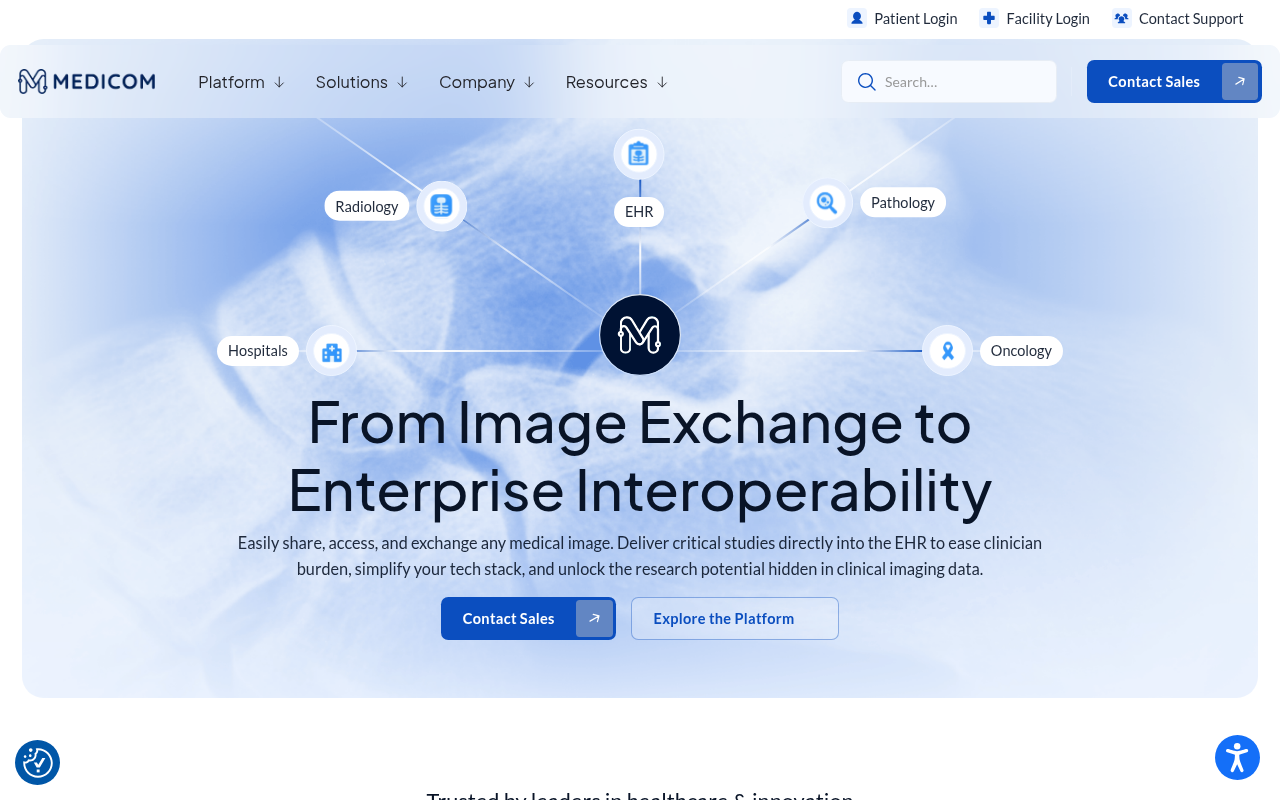
Medicom connects imaging systems and standardizes incoming data so health systems can exchange outside studies and deliver them into clinical EHR workflows.
Best for
- Health systems consolidating outside-image intake and exchange
- Imaging teams connecting fragmented sources to clinical records
Not ideal for
- Buyers assuming interoperability equals full AI semantic standardization
- Organizations seeking an image-interpretation or autonomous diagnosis system
Bottom line
Medicom is worth considering for health systems that need a unified route from outside imaging sources into clinical workflows. Its strongest case is interoperable intake and delivery, with the required normalization depth defined before the purchase.
Score breakdown
Weights: Outcomes 35% · Product 30% · Implementation 20% · Pricing clarity 15%.
Medicom is most useful to enterprise imaging and IT teams trying to get outside studies into the patient record without repeated manual transfers. It brings intake and reconciliation closer to the clinician’s existing EHR workflow. Enlitic is relevant where a purchase includes imaging-data normalization or migration, but the products should be compared against the exact data problem being solved.
The purchase belongs in an enterprise imaging budget, including interfaces and implementation, not a per-user image-viewer subscription. Medicom’s emphasis is on exchange and orchestration across institutions and systems. A project centered on semantic labeling or AI-driven standardization of a large imaging archive may require capabilities beyond the documented interoperability workflow.
- Outcomes and workflow value (7.8): Named imaging customers describe automation and improved exchange processes.
- Product and service depth (8.1): Intake, normalization, orchestration, reconciliation, and EHR access form a substantial interoperability offering.
- Ease of implementation (7.0): Source mappings, patient matching, and EHR workflow integration need technical validation.
- Pricing clarity (6.0): Enterprise pricing is sales-scoped, with no public rate for the reviewed offering.
What Medicom Normalizes and Connects
The enterprise imaging page describes ingesting information from sources including teleradiology, patient portals, point-of-care ultrasound, and digital pathology. It converts DICOM header information into standardized FHIR resources using AWS HealthLake and orchestrates delivery into the EHR.
DICOM describes medical imaging information, while FHIR supports healthcare data exchange. Connecting these representations helps receiving systems use incoming studies in context. That does not establish equivalent semantic understanding of every image, modality, or historical label. The source fields and resulting clinical record need to be checked against the project’s actual requirements.
Workflow Value for Imaging Teams
SMART on FHIR applications allow exchange, reconciliation, and intake to launch within a patient’s EHR context. This reduces the need to open separate tools and re-establish the patient identity. The practical benefit is a more complete history available where care decisions are made.
Michigan Medicine’s published account describes needing automation for a large intake volume, and SMIL describes faster matching and search. These accounts support the workflow case. They do not prove that every installation will eliminate duplicates, reduce spending by the same amount, or resolve all identity exceptions automatically.
Migration Scope and Safety Boundaries
For a replacement or migration project, the useful questions concern accepted sources, normalization rules, patient matching, exceptions, reconciliation, and delivery into downstream systems. Moving a study successfully is only part of the task if its metadata causes the receiving system to classify it incorrectly.
Medicom can be evaluated alongside Enlitic for overlapping normalization and migration requirements, but Enlitic’s semantic-standardization functions are not all interchangeable with header conversion and routing. Image interpretation remains the responsibility of appropriate clinical systems and clinicians. Medicom’s separate research-data offering also should not be confused with the production clinical workflow.
Product and service details: home.medicom.us, home.medicom.us.
Company scale
Growjo estimates Medicom Technologies annual revenue at $7.9 million. Scale source
What People Say
What people like
"We needed a platform with comprehensive automation tools and rigorous security standards, and Medicom was our selected partner."
"The Medicom solution was transformative because it simplified our internal workflows while managing the complexity of a large external network."
What people don't like
"We still need to verify that the normalization rules handle our own imaging data correctly."
Where customer reviews couldn't be found, our analysts attempted to give a voice to buyer sentiment, drawing on real information from review sites, forums and product documentation.
Based on: Product or service details, Product or service details.
This comparison is limited to overlapping imaging normalization and migration work. Header normalization, routing, and AI semantic standardization have different scopes.
Competitor landscape
| Vendor | Overall | Ease of implementation |
|---|---|---|
| Medicom | 7.5 | 7.0 |
| Enlitic | 6.9 | 6.5 |
| Laurel Bridge Software | 7.4 | 6.6 |
Pricing
| Item | Detail |
|---|---|
| Enterprise imaging | A sales-scoped agreement; no current public dollar price. |
| Scope to compare | Source connections, migration volumes, normalization rules, EHR integration, exception handling, and support. |
| Research services | Separate research-data work should be distinguished from clinical exchange licensing. |
Leadership

Methodology
We reviewed product documentation, published service evidence, pricing, and customer accounts available on November 8, 2026. Scores are editorial assessments on a ten-point scale. The overall score weights outcomes and workflow value at 35%, product at 30%, implementation at 20%, and pricing clarity at 15%. Company-website testimonials are vendor-selected accounts.
Existing peer scores are carried from the linked HIR reviews.
Sources
- Healthcare Industry Reviews analysis of the product, service, and pricing sources below, conducted November 2026.
- home.medicom.us · solutions/enterprise imaging interoperability
- home.medicom.us · about us
- growjo.com · company/Medicom_Technologies